

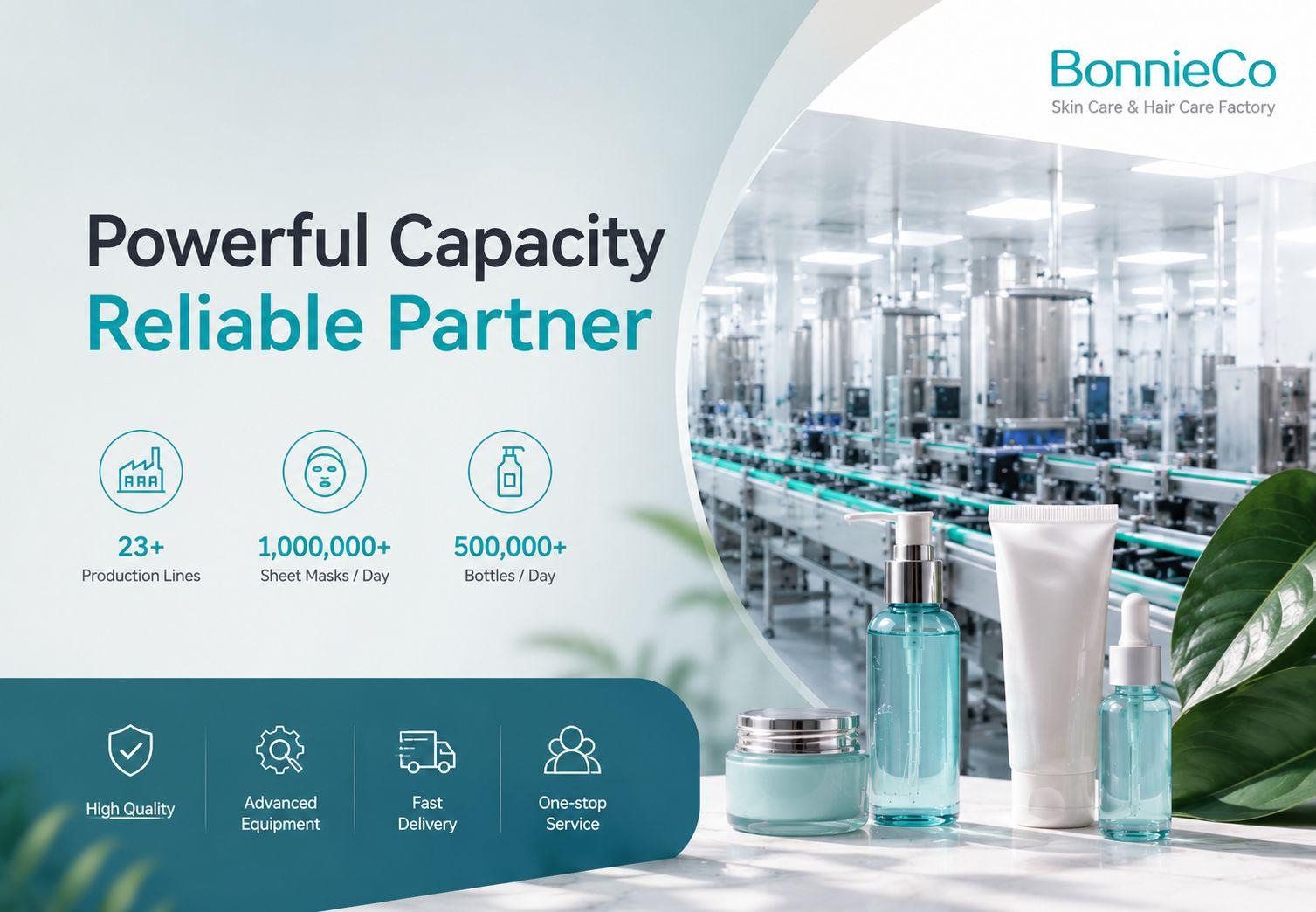
In the beauty industry, many brands focus on product design, marketing, and social media growth. These parts are important, but there is one factor that quietly decides whether a brand can scale or struggle: production capacity.
When a product suddenly becomes popular, orders can grow much faster than expected. That sounds like a success story, but it often creates pressure on the supply chain. If a factory cannot deliver on time, the brand may lose customers, damage its reputation, and miss sales opportunities that are hard to recover.
This is why cosmetic manufacturing capacity is not just a technical detail. It is a core part of brand survival and growth.
So how does production capacity actually affect real business outcomes?
When Orders Increase, Why Does Delivery Become the Real Challenge?
A sudden rise in demand is something every brand hopes for. But once it happens, the real test begins: fulfilling those orders on time.
Sudden growth creates immediate pressure
When sales increase quickly, factories must scale production just as fast. If they cannot, delays start building up. Even small delays can affect customer trust and lead to cancellations.
In many cases, small factories do not have enough machines, staff, or structured planning. Their cosmetic factory production capacity is limited, so orders must be processed step by step instead of in parallel.
Delays directly affect brand reputation
Customers today expect fast and reliable delivery. When products are late, the impact goes beyond inconvenience.
It can lead to negative reviews, lost repeat customers, and reduced brand loyalty. In a competitive market, customers often switch to another brand rather than wait.
Capacity becomes more important than demand
This is where many brands realize something important. It is not just about getting more orders. It is about being able to fulfill them consistently.
So how do brands make sure they are prepared from the start?
Why Production Capacity Is a Key Factor When Choosing a Factory
Choosing a manufacturing partner is not only about price or product quality. It is also about whether the factory can support long-term growth.
Capacity determines scalability
A private label manufacturer may offer great formulas and packaging options, but without strong capacity, growth becomes limited.
If demand doubles, the factory must be able to handle it without slowing down or lowering quality.
Strong factories support market expansion
A reliable skincare manufacturer does more than produce products. It helps brands expand into new markets and respond to trends quickly.
This is where cosmetic manufacturing capacity becomes a strategic advantage rather than just an operational detail.
Stability matters more than one-time success
A single successful product launch is not enough. Brands need consistent production over time. That is why many experienced companies carefully evaluate capacity before signing long-term agreements with a cosmetic OEM factory.
But what really separates small factories from large ones?

Small Factories vs Large Factories: What Is the Real Gap?
The difference between small and large manufacturers is often bigger than brands expect.
Small factories face structural limitations
Small workshops usually depend on manual labor and limited equipment. This creates several challenges:
They have fewer production lines, smaller storage space, and slower processing speed. When multiple orders arrive at once, delays are almost unavoidable.
Large factories operate at a different scale
A cosmetic factory China with large-scale operations uses automation and structured workflows. Multiple production lines operate at the same time, allowing different products to be manufactured in parallel.
This is especially important for brands with diverse product ranges.
Efficiency across the entire process
From sampling to packaging, large factories are more streamlined. A single cosmetic production line can handle multiple steps automatically, reducing delays and human error.
Why evaluation is essential before choosing a partner
Brands should always check whether a skincare supplier China has stable long-term capacity, not just short-term production ability.
So what happens when factories expand even further with more production lines?
How Do Multiple Production Lines Improve Speed and Stability?
Production lines are the backbone of manufacturing speed and flexibility.
Parallel production increases output
When a factory has many production lines, it can produce different products at the same time. This reduces waiting time and increases efficiency.
This is one of the main reasons fast cosmetic production is possible in large factories.
Automation improves consistency
Modern equipment handles filling, sealing, labeling, and packaging. This reduces manual work and ensures consistent quality across large batches.
It also helps reduce mistakes that can happen during high-volume production.
Peak season readiness
During major sales events or seasonal demand spikes, factories with strong systems can continue producing without interruption.
This is what allows quick delivery cosmetics even during high-pressure periods.
Capacity is not just size, but coordination
Having more production lines is not enough on its own. What matters is how well they are managed together as a system.
But how does this scale translate into real production numbers?
What Does High Volume Production Actually Look Like?
Real production numbers help explain why capacity matters so much.
Facial masks require massive output
A strong skincare manufacturer may produce up to one million facial masks per day. This includes every step from filling essence to final packaging.
Facial masks are often used in large campaigns, which means demand can rise suddenly and dramatically.
Lotions and skincare products need fast turnover
A cosmetic OEM factory that produces hundreds of thousands of lotion bottles daily gives brands the ability to react quickly to market trends.
This speed is essential in competitive product categories.
Production scale supports market timing
If a brand can launch quickly and restock without delay, it has a stronger chance of winning market share.
Capacity supports both risk and opportunity
High production capacity reduces the risk of shortages while increasing the ability to capture sudden demand spikes.
But speed is not the only factor brands need. Timing also depends on development.
Why Is Fast Sampling and Fast Production So Important?
Speed in product development is now a key advantage in the beauty industry.
Trends change quickly
Consumer preferences shift rapidly, especially in skincare. A trending ingredient or product type may only stay popular for a short time.
Sampling reduces risk
Fast sampling allows brands to test ideas before committing to large production runs. This helps avoid wasted investment and improves product decisions.
Smooth transition to mass production
A strong cosmetic OEM factory can move quickly from sample approval to full production without long delays.
This is where fast cosmetic production becomes a real competitive advantage.
Timing can decide success
If a product launches too late, even a great idea can lose its market potential.
So how can brands avoid missing opportunities like this?
How Can Brands Avoid Supply Chain Problems Before They Start?
Choosing the right factory is one of the most important decisions for long-term success.
Production lines and output capacity
Brands should always ask how many production lines are available and how much each can produce daily.
Automation level
Higher automation usually means faster production and more stable quality control.
Warehouse and logistics support
Good storage systems help manage inventory and reduce delivery delays.
Delivery history and reliability
Past performance is often the best indicator of future stability.
A reliable skincare supplier China will be transparent about all these areas.
Long-term partnership thinking
The best partnerships are not just about one order. They are about building stable growth over time.
Conclusion
In the beauty industry, product quality and marketing are important, but they are not enough on their own. Without strong production support, even successful brands can struggle to grow.
A cosmetic factory China with strong cosmetic manufacturing capacity allows brands to scale safely, respond to demand quickly, and maintain customer trust.
Whether it is facial masks, lotions, or skincare innovations, working with a strong cosmetic OEM factory ensures that growth does not stop when demand increases.
At the end of the day, marketing may create demand, but production capacity is what delivers it.
FAQs
What is cosmetic manufacturing capacity?
Cosmetic manufacturing capacity refers to how much a cosmetic OEM factory can produce within a specific time. It includes daily output, number of production lines, and how efficiently the factory can handle different product types like skincare, masks, and lotions.
Why is production capacity important for brands?
Strong cosmetic factory production capacity ensures that brands can meet sudden increases in demand without delays. It helps prevent stock shortages, protects brand reputation, and supports stable growth in competitive markets.
How do I know if a skincare manufacturer has enough capacity?
Check their number of production lines, daily output, level of automation, warehouse size, and delivery history. A reliable skincare supplier China will provide clear and transparent information.
What happens if a factory has low capacity?
Low capacity can lead to slow production, delayed shipments, and missed sales opportunities. It can also harm customer trust and reduce repeat purchases.