
When people hear about sunscreen, they usually think it is just one simple product that protects skin from the sun. But if you are a skincare brand or planning to work with a sunscreen manufacturer, you quickly realize something very important. Not all sunscreens are made the same.
One of the biggest product decisions today is tinted vs untinted sunscreen. At first, this might sound like only a color choice. But in real manufacturing, this difference changes everything, from raw materials to production methods and even quality control.
So why does this matter so much for brands working with a skincare OEM factory or cosmetics factory? And how does a professional sunscreen manufacturer handle these differences at scale?
Let’s break it down step by step in a way that makes everything clear.
Why Are Brands Even Choosing Between Tinted and Untinted Sunscreen?
Before we go into factories and machines, we should ask a simple question. Why are there two types of sunscreen in the first place?
Untinted sunscreen is the classic version. It is usually white or transparent when applied. Many brands choose it because it feels light and works for all skin tones without changing appearance.
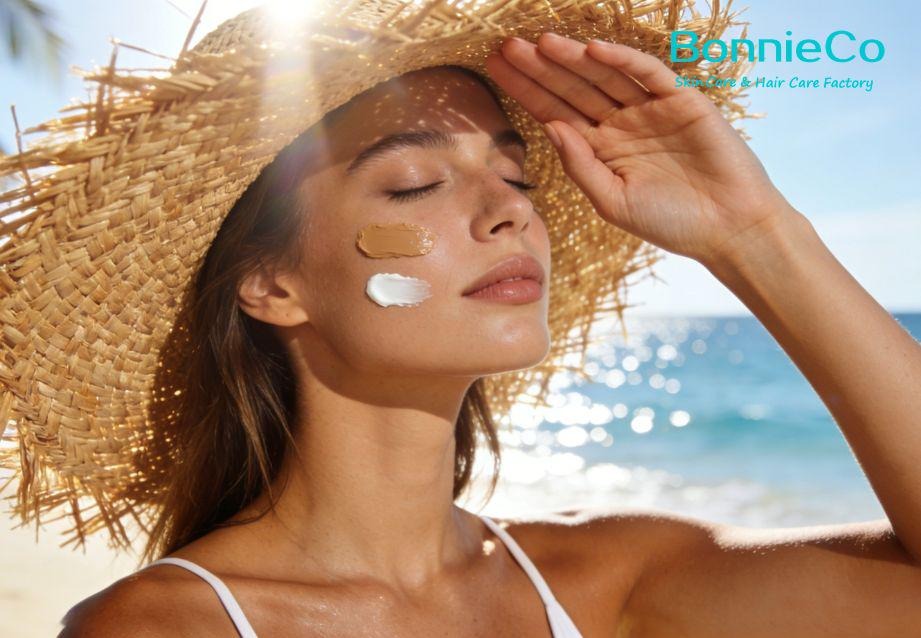
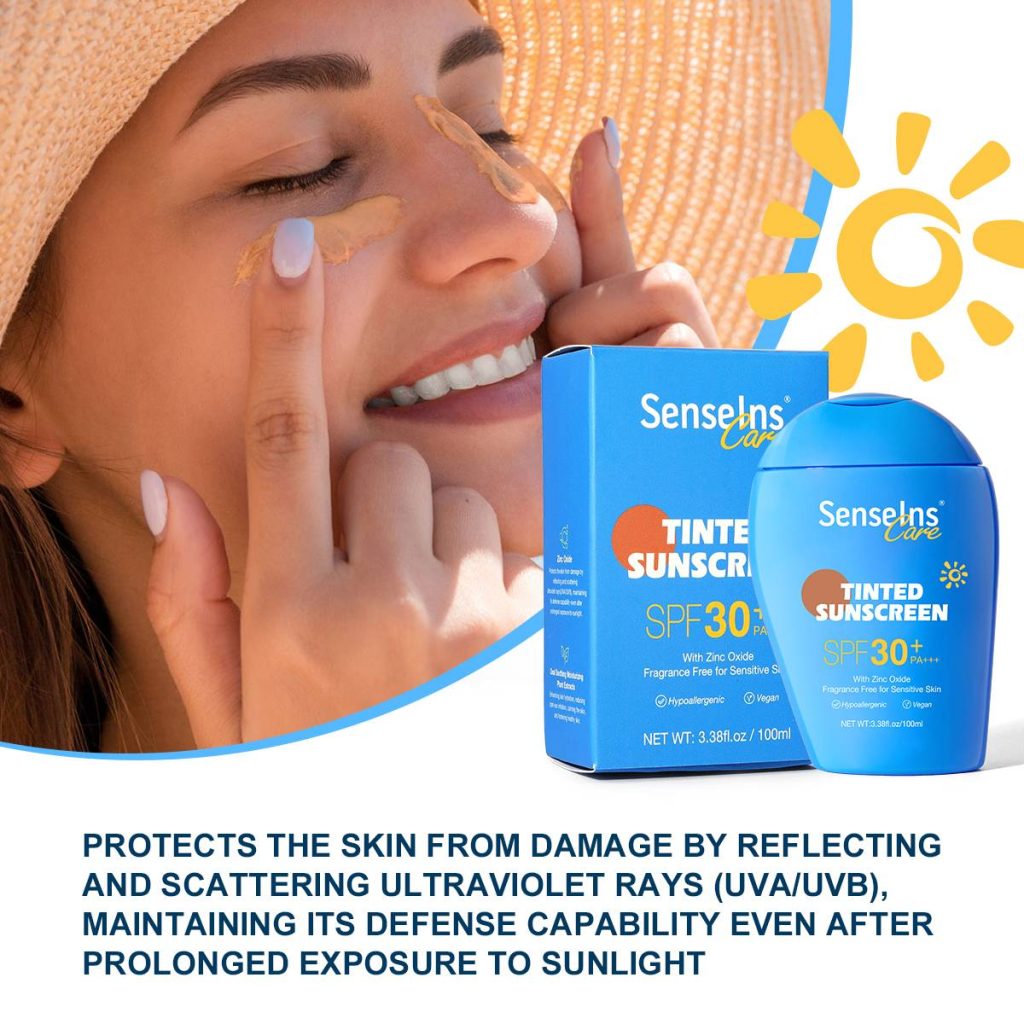
Tinted sunscreen, on the other hand, has a light color. It often uses iron oxide pigments. This helps even out skin tone and also adds extra protection against visible light.
So when we talk about tinted vs untinted sunscreen, we are really talking about two different user experiences.
But here is where things get interesting. Once a brand decides which type to produce, the real challenge begins inside the factory. So what actually changes during production?
What Happens Inside a Professional Sunscreen Manufacturer?
To understand the difference properly, we need to look at how a modern sunscreen manufacturer works.
At BonnieCo, a professional cosmetics manufacturer and beauty manufacturer in China, sunscreen production is not just mixing ingredients. It is a controlled industrial process.
Our factory includes advanced German Siemens emulsification systems with over 30 automated units. These systems help ensure ingredients are mixed evenly and consistently. This is very important for both tinted sunscreen factory production and untinted sunscreen production.
We also operate a daily emulsification capacity of 150 tons, along with 23 production lines. This allows us to handle both small and large orders for private label sunscreen and sunscreen contract manufacturing.
But even with advanced equipment, tinted and untinted formulas behave very differently. So what exactly changes between them?

What Is the Real Difference Between Tinted and Untinted Sunscreen Manufacturing?
Now we come to the core topic: tinted vs untinted sunscreen in actual production.
At first glance, both products may look similar in a mixing tank. But under the surface, they behave very differently because of raw materials and formulation needs.
Here is a simple comparison:
| Category | Untinted Sunscreen | Tinted Sunscreen |
| Main Goal | Clear finish, no white cast | Natural skin tone coverage |
| Key Ingredients | UV filters, physical or chemical | UV filters plus iron oxide pigments |
| Mixing Challenge | Smooth texture, stability | Even pigment distribution |
| Quality Focus | SPF accuracy, safety | Color consistency, coverage |
So what does this table really tell us?
It shows that untinted sunscreen is mainly about clarity and skin feel, while tinted sunscreen is about color control and balance. And this difference changes everything in production planning for a skincare OEM factory.
Why Is Untinted Sunscreen Easier but Still Challenging?
You might think untinted sunscreen is simple because it has no color. But in manufacturing, simplicity is not always easy.
For a physical sunscreen manufacturer, the biggest challenge is avoiding the white cast effect. This happens when mineral UV filters are not fully blended into the formula.
Temperature control, mixing speed, and emulsification time must be extremely precise. If anything goes wrong, the texture becomes uneven or heavy on the skin.
So even though untinted sunscreen looks basic, it still requires strong technical control from a sunscreen manufacturer.
But if untinted sunscreen is already challenging, what happens when we add pigments into the mix?
Why Is Tinted Sunscreen More Complex to Produce?
This is where things become much more sensitive.
Tinted sunscreen uses iron oxide pigments. These pigments must be perfectly dispersed so that the final product looks smooth and natural on the skin.
If dispersion is not handled correctly, the product can become streaky, uneven, or unstable over time. This is why many brands rely on a tinted sunscreen factory with advanced technology.
At BonnieCoFactory, we use pre-dispersion techniques and intelligent emulsification systems to solve this issue. This ensures that every batch looks consistent, even in large-scale sunscreen contract manufacturing.
So when brands ask about private label cosmetics manufacturer options, tinted sunscreen is often one of the most technically demanding categories.
But how do we ensure both tinted and untinted sunscreens meet high-quality standards?
How Quality Control Changes Between the Two Types
Quality control is where tinted vs untinted sunscreen becomes even more different.
For untinted sunscreen, the focus is on SPF performance, microbial safety, and long-term stability. The product must protect skin reliably without irritation.
For tinted sunscreen, there is an extra layer of control. Color consistency becomes just as important as protection. Even a small shift in pigment balance can change how the product looks on skin.
This is why a professional cosmetics factory must test both texture and appearance across multiple production batches.
At BonnieCo, we treat both categories with strict quality systems inside a Class 100,000 cleanroom environment. This helps maintain consistency for global B2B wholesale cosmetics partners.
So with all these challenges, why do brands still choose specialized manufacturers instead of general suppliers?
Why Choosing the Right Sunscreen Manufacturer Matters
When a brand enters the sunscreen market, the choice of manufacturing partner can decide product success or failure.
A strong sunscreen manufacturer does more than just produce products. It solves technical problems before they reach the customer.
At BonnieCo, we support brands through full sunscreen contract manufacturing services. This includes formulation support, production scaling, packaging, and quality testing.
As a skincare OEM factory with 15 years of experience, we understand both tinted and untinted sunscreen production at an industrial level. This helps brands avoid common issues like instability, uneven texture, or inconsistent color.
For companies looking for private-label sunscreen solutions, this experience becomes a major advantage.
But what does this mean for your brand in practical terms?
How BonnieCo Supports Both Tinted and Untinted Sunscreen Brands
The real advantage of working with a professional beauty manufacturer is scalability and reliability.
With 150 tons of daily emulsification capacity, BonnieCo can support both growing startups and established global brands. Whether you are launching a new private label sunscreen or expanding your existing line, production stability is key.
Our cleanroom environment ensures hygiene and consistency, while our automated systems reduce human error in production.
This is especially important for tinted sunscreen factory production, where pigment consistency must remain stable across thousands of units.
At the same time, we also ensure untinted sunscreen maintains a smooth, invisible finish without white cast.
So whether it is tinted or untinted, the goal is always the same. Deliver safe, effective, and high-quality sunscreen products that meet global standards.
Final Thoughts
When we compare tinted vs untinted sunscreen, it is easy to think the difference is only about appearance. But in reality, it is a manufacturing decision that affects everything from raw materials to production systems.
If you are a brand working with a sunscreen manufacturer, the most important question is not just what product you want. It is who you trust to make it.
A professional partner like BonnieCo provides more than production. It provides stability, technical support, and global manufacturing experience.
Whether you are looking for a physical sunscreen manufacturer, a cosmetics factory, or a full private label cosmetics manufacturer, the right partner can turn your idea into a scalable product.
Explore sunscreen solutions and product options
Because in the end, success in skincare is not only about formulation. It is about choosing the right factory that understands both tinted and untinted sunscreen at every level.
Foshan BonnieCo Biotechnology Co., Ltd. (BonnieCo Group): Self-Owned Factory · Own Brands · Global Certifications · 15 Years of Smart Beauty Manufacturing. We operate three core business divisions:
1. Guangzhou LocRoyal Cosmetics Co., Ltd.: Hair care OEM + self-owned brands including PROINSCARE, PURC
2. Guangzhou BonnieCo Cosmetics Co., Ltd.: Skin care & color cosmetics OEM + self-owned brands including SenseInsCare, Jellyprim
3. A 50,000㎡ self-owned production base in Foshan
FAQs
What is the main difference intinted vs untinted sunscreen?
Tinted sunscreen contains iron oxide pigments for color and added visible light protection, while untinted sunscreen is usually clear or white and focuses on UV protection without changing skin tone.
Is tinted sunscreen harder to manufacture?
Yes. Tinted sunscreen requires precise pigment dispersion to ensure even color and prevent streaking or batch variation during production.
Can one sunscreen manufacturer produce both types?
A professional sunscreen manufacturer or skincare OEM factory can produce both, but it requires advanced equipment and strict quality control systems to maintain consistency in each formula type.